English🍉
˚༄ 。 Միջին դպրոցի 9.4 դասարան༄.°

1. Write there is or there are as in the example.
There are three girls.
There is a table.
There are a lots of flowers.
There are two dogs.
There is a slide.
There are two boys.
2. Fill in there is, there are, is there or are there.
Is there any butter on the bread?
Are there any birds on the tree?
There is some lemonade in the bottle?
Is there a horse on the field?
Is there any people in the room?
There are some matches in the box.
3.Write short answer to the questions.
Is grandpa sleeping?-no he isn’t
Is mother cooking dinner?-yes she is.
Are they doing their homework?-yes they are.
Is she eating lunch?-no she isn’t
Are you going shopping?-yes, I am
Is he digging in the garden?-yes he is
Nouns-countable and uncountable.
Put the words in the correct groups.
Countable-sandwiches, cakes, orange, apples, picnic, bananas.
Uncountable-ice-cream, grass, waters, juice, cheese, rain.
Nouns-countable and uncountable.
Make sentences
I’ve got some water in my bag.
There are some bananas on the table.
Is there any chocolate in the fridge?
He hasn’t got any time.
I need some green paper.
There aren’t any grapes left.
There isn’t any rice.
Have you got a new toy?
The first day of middle school is will be a little bit stressful. I’m very scared and excited. The good thing is I can make new friends and have meet new teachers. Speaking of friends, I will tell you a little bit about my close friend. Her name is Susanna and we hangout a lot. I met Susie a year ago. I like being friends with Susie, and I hope that Susie will be in my class. I would love to sit next to her in the classroom because I always with her. I think I will have a good time with my new class.
Game results📊
Activities📑
Mother’s Day, holiday in honour of mothers that is celebrated in countries throughout the world. In its modern form the holiday originated in the United States, where it is observed on the second Sunday in May. Many other countries also celebrate the holiday on this date, while some mark the observance at other times of the year. During the Middle Ages the custom developed of allowing those who had moved away to visit their home parishes and their mothers on Laetare Sunday, the fourth Sunday of Lent. This became Mothering Sunday in Britain, where it continued into modern times, although it has largely been replaced by Mother’s Day. Mother’s Day is celebrated on Sunday, May 8, 2022.
Anna Jarvis of Philadelphia, whose mother had organized women’s groups to promote friendship and health, originated Mother’s Day. On May 12, 1907, she held a memorial service at her late mother’s church in Grafton, West Virginia. Within five years virtually every state was observing the day, and in 1914 U.S. Pres. Woodrow Wilson made it a national holiday. Although Jarvis had promoted the wearing of a white carnation as a tribute to one’s mother, the custom developed of wearing a red or pink carnation to represent a living mother or a white carnation for a mother who was deceased. Over time the day was expanded to include others, such as grandmothers and aunts, who played mothering roles. What had originally been primarily a day of honour became associated with the sending of cards and the giving of gifts, however, and, in protest against its commercialization, Jarvis spent the last years of her life trying to abolish the holiday she had brought into being.
Festivals honouring mothers and mother goddesses date to ancient times. The Phrygians held a festival for Cybele, the Great Mother of the Gods, as did the Greeks for the goddess Rhea. Likewise, the Romans adapted the practice to their own pantheon. Some countries have continued to observe ancient festivals; for example, Durga-puja, honouring the goddess Durga, remains an important festival in India.
172. Change to the plural as in the example.
That is an ox.-Those are oxen.
I am a student.-We are students
She is a women.-Those are women.
This is a goose.-Those are geese.
He is a good doctor.-Those are good doctors.
That is a big box.-Those are boxes.
173.Fill in with “some” or “any”
There are some glasses on the table.
Is there any milk in the fridge?
There is some water in the glass.
There isn’t any coke in the bottle.
Are there any students in the classroom.
174.Fill in the blanks using “in” “at” or “on”
On Sunday.
In the afternoon.
At night
At 3 o’clock
On February 1st
On summer
On Easter.
On Thursday morning.
In the morning.
In 1992.
On Christmas.
In August.
175.Fill in the blanks with Simple Present or Present Continuous.
Every day my father drives to work he works in a bank. He likes his job.
He wakes up on 7 o’clock every morning. He makes breakfast for us all.
We are eating at the moment. He always leaves at half past seven. At the moment he is laughing because Ted, my brother told him a joke.
176. Fill in “who”, “whose”, “where”, “what time?” And “why?”
What time is it?-It’s 8:30
Whose is this car?-It’s my fathers.
Who is she?-She’s my sister.
Where is the milk?-It’s in the fridge.
Why are you wearing a coat?-because it’s cold outside.
Why did she leave?-it’s 6:20
177.Look at the picture and complete the sentences with the correct prepositions from the list below.
Look at this pet shop. There is a goldfish bowl on the table. There is a goldfish in the bowl. The cat is next to the bowl. The dog is under the table. And above the goldfish bowl there is a bird in the cage. The goldfish bowl is between the cat and dog biscuits. There’s a ball behind the plant.
178. Fill in “how much” or “how many”.
How much money have you got?
How much water is there in the bottle?
How many trees are there In the garden?
How much milk does the baby drink?
How many friends have you got?
179.Find the mistakes and correct them.
1. Is waiting
2. Is taking
3. Is
4. It was raining
5. Is holding
6. likes
7. Are
180.Fill in with simple past.
1. Is driving
2. Is sleeping
3. Is
4. arrived
5. ran
6. ate
7. played
8. left
9. went
10. had
11. swam
181.Fill in the blanks with the simple past
1.did you go?
2.went
3.did you stay?
4.stayed
5.had
6.did you?
7.didn’t go anywhere
8.was
9.stayed
10.came
11.were
182.Put in the verbs in Simple Present or Present Continuous.
1.are
2.am
3.is
4.works
5.am
6.is
7.where are they doing?
8.is at the shops
9.are buying
10.are playing
11.are you doing?
12.am watching
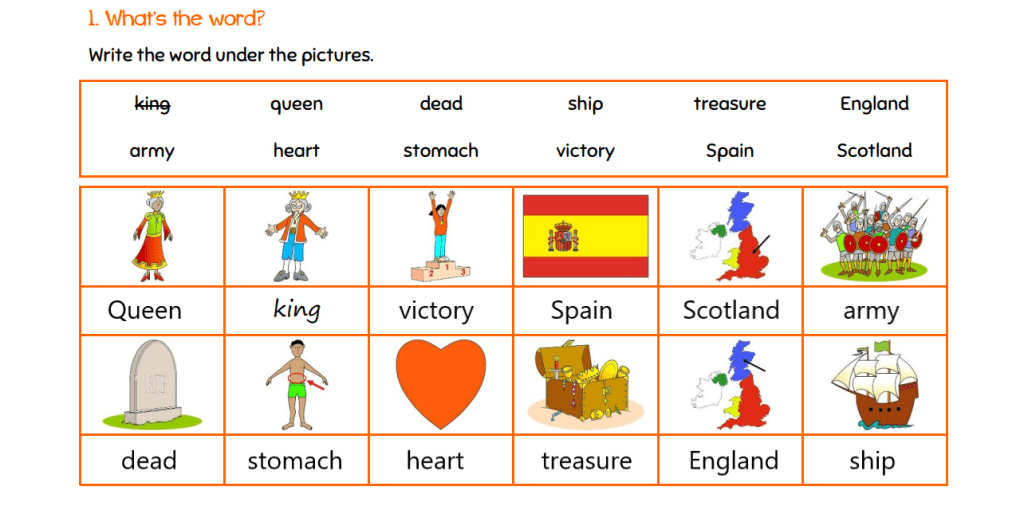
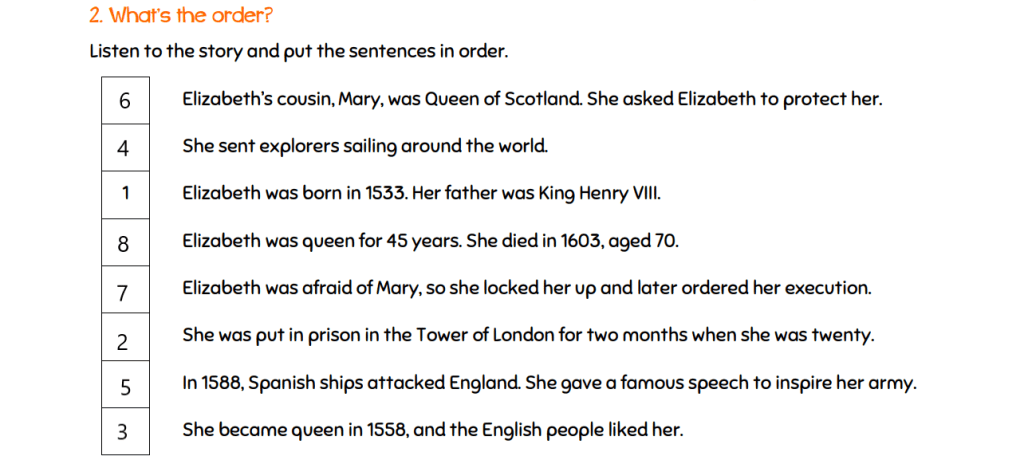
Elizabeth was born nearly 500 years ago, in 1533. Her father, King
Henry VIII, had six wives. When Elizabeth was two, her father ordered
her mother’s execution.
‘Off with her head!’
Elizabeth was very clever, but she had a difficult childhood with her
bad-tempered father and so many stepmothers. She was put in
prison in the Tower of London for two months when she was twenty. Elizabeth became queen in 1558.
‘Your sister is dead. You are the new queen.’
The English people liked Elizabeth and called her ‘Good Queen Bess’. But Elizabeth was often badtempered and bossy.
‘I said give me my wig!’
Elizabeth sent explorers sailing around the world. In 1577, Sir Francis Drake set sail in his ship, the
Pelican.
‘Goodbye, Francis. Discover some new countries and bring me back some Spanish treasure!’
In 1588, the Spanish king sent a huge fleet of ships to attack England. It was called ‘the Spanish
Armada’. Elizabeth gave a famous speech to inspire her army.
‘My loving people! I know I have the body of a weak woman, but I have the heart and stomach of a
king. I will live or die amongst you all, but I know we shall have a famous victory!’
Spain lost the battle.
Elizabeth’s cousin, Mary, was Queen of Scotland. Mary had to run away from Scotland and she asked
Elizabeth to protect her.
‘Please protect me, Elizabeth!’
Elizabeth was afraid that Mary wanted to become Queen of England. She locked Mary up. Nineteen
years later she ordered Mary’s execution.
‘Off with her head!’
Elizabeth was queen for 45 years. It was a golden age for England. She died in 1603, aged 70, and
James I, Mary’s son, became king.
‘Queen Elizabeth is dead. Long live King James!’
 ୨ৎ Արփի Փիրումյան 𝜗ৎ