Laughter is very good for us because it releases tension.
1. Are you humorous?
I can’t say I’m humorous.
2. Can you tell about a time when you were very funny?
I feel funny at nights, because its easier to make people laugh at night.
3. What kind of humor do you like? Do you like many kinds?
I laugh at any kind of humor, I can’t pick one.
4. Why do people say laughter is the best medicine?
Laughter is good for our heart, blood circulation and immune system.
5. Can you tell about a time when you laughed at yourself?
6. What type of humor do you like?
I can’t pick one type, I laugh at every joke that my sister makes.
7. Do you like to tell jokes?
Yes, but most of them aren’t funny.
8. Are you a good joke teller?
I don’t think so.
9. What sort of things make you laugh?
Every stupid thing that my sister does.
10. How frequently do you laugh every day?
I don’t count how often I laugh, but I can say that I do it often.
11. Do you laugh out loud or do you chuckle quietly?
Depends where am I and who’s around me. I laugh loudly when I’m with my close people, but when I’m in public I try to be quiet.
12. Do you sometimes laugh in situations which are not amusing?
I do, but I try to hide the fact that I laugh.
13. Laughter is catching. Do you start laughing when you see or hear other people laughing? Why do you think this happens?
I think it happens because the other people’s laugh is specifically funny. I laugh when I see my sister or brother laughing.
14. What is the difference between “laughing at someone” and “laughing with someone”?
15. Does your language have equivalent expressions for
“I nearly died laughing!” or “I cracked up (with laughter)!”?
“He was the laughing stock”
“Don’t make me laugh!”
Рубрика: English 8
Создание игры пазл с Беллой Мовсисян

Winter camp with Miss Anahit 2025
Winter camp, the first day
Today Miss Anahit introduced us to our activities and we talked about what are we going to do in next few weeks of this winter camp. After that we met some of our friends from other winter camp groups and the 12th graders, that came to introduce their project about movies and TV series. We also made a small discussion in English with them about our hobbies and with that we introduced ourselves to each other. It was so fun to hear something new from people older than you, I cant wait for our next class together. Few minutes later we met another 12th graders that suggested us to make another discussion about our favorite books, movies and genres. It was also a nice opportunity to understand high school students’ interests more. After the lunch break we had our last free class, so each student just minded his own business. After that our first day at Miss Anahit’s winter camp got to the end!
Our friends from Lanhaxbyur
Today at he morning we met our friends from Lanjaxbyur. We spent the whole day with them. I was so glad to meet Miss Lindon and her students 10th graders. We made a small discussion in English with them about our school. We talked about the education in Bleyan and other schools. It was so interesting to listen about Miss Lindon’s life and why did she come to Armenia. Mister Yura joined us to listen to Miss Lindon and her students. After that we went to the dance classes to Miss Meri and other winter camp group. We learned a new dance with Miss Meri, Miss Lindon and her students. Immediately after the dance class we went to the music class. We had the opportunity to hear one of Miss Lindon’s student’s precious voice. I really liked how she sang. Today we also played a small game that Miss Lindon recommended. We had to pick a card, read the question on it and anyone, who wanted to answer it just answers it. It was so fun to hear something new about each other’s life. And with that our second day at Miss Anahit’s winter camp came to an end.
Discussion about Artificial intelligence
Today Mister Yura visited us one more time, but this time we also had few 12-th graders with us. The topic for today’s discussion was AI. Artificial intelligence (AI) is a set of technologies that enable computers to perform a variety of advanced functions, including the ability to see, understand and translate spoken and written language, analyze data, make recommendations, and more. I’m glad that I could discuss AI with someone. It was so fun today!
Lebanese and Armenian kitchen
Our classmates parents from Lebanon visited our winter camp today! Today we were at kitchen all day. We had the opportunity to get to know more about Lebanese kitchen. Because Greg’s mother helped us to make Lebanese Mghli, Kastre, Zartar and pepper bread. Beside Lebanese kitchen, our other classmates grandmother showed us how to make the traditional Armenian gata. It was so fun and good! I hope I will meet them one more time, to make something with them again!
Ձմեռային ճամբարի մեր այսօրը (01.31.2025)
Այսօր մեզ միացավ Ընկեր Բելլան և ներկայացրեց մեզ իր նախագիծը` создание игры пазл.
Projects I’ve done while winter camp
I’ve participated in few projects while this winter camp. For example I was present in the discussions about Artificial intelligence. I’ve done the Բառբարային նախագիծ with Miss Edita. Also I was present in Lebanese and Armenian kitchen project.
Self-assessment
I guess I’ve gained a lot of knew things for me from Miss Anahit’s winter camp. For example I’ve got to know more about Artificial Intelligence, other countries traditional food and movies.
Test on passive voice
1. Choose the correct answer.
1. Drinks and snacks serve / are served in the buffet car.
2. We gave / were given our boarding passes at the check-in desk.
3. The passenger wore / was worn his seatbelt.
4. The flight attendant has made / has been made a mistake with my change.
5. The waiting room is cleaning / is being cleaned.
2. Complete the sentences with the passive form of the verbs in brackets. Use the correct tense.
1. Each year, thousands of suitcases are lost (lose) by different airlines.
2. Kay is pleased because her favourite perfume has been reduced. (reduce) in the duty-free shop.
3. We waited until the departure gate was announced (announce).
4. The hard shoulder will be closed (close) next week for emergency repairs.
5. They were stopped (stop) at passport control last night.
6. The ticket office is used (use) by millions of passengers every week.
7. George couldn’t find his bag because it had been stolen (steal).
8. You will be taken (take) to the airport tonight by taxi.
3. Complete the second sentence with the correct form of the passive. Use by where necessary.
1. Charles Dickens wrote Oliver Twist.
Oliver Twist was written by Charles Dickens.
2. Vandals have damaged the petrol station.
The petrol station has been damaged by vandals.
3. They will add four more carriages to the train at the next station.
Four more carriages will be added to the train at the next station.
4. Someone had left the bag at baggage reclaim.
The bag had been left at baggage reclaim.
5. Low-cost airlines sell many cheap flights.
Many cheap flights are sold by low-cost airlines.
6. They are repairing the tracks so there aren’t any trains.
The tracks are being repaired.
Exercise on Passive Voice – Simple Present
Complete the sentences (Active or Passive Voice). Use Simple Present.
1. He sells (sell) cars. — Cars are sold by him.
2. The blue car is sold (sell).
3. In summer, more ice-cream is eaten (eat) than in winter.
4. She calls (call) her grandparents every Friday. — Her grandparents are called by her every Friday.
5. The letters are typed (type).
6. He takes (take) his medicine every day. — The medicine is taken by him every day.
7. Jane is not taken (take / not) to school by her father.
8. We go (go) to school by bus. — We are taken to school by bus.
9. She does not work (work / not) for a bank.
10. Milk is kept (keep) in the refrigerator.
Rewrite the sentences in passive voice.
He opens the door. – The door is opened by him.
We set the table. – The table is set by us.
She pays a lot of money. – A lot of money is paid by her.
I draw a picture. – The picture is drawn by me.
They wear blue shoes. – The blue shoes are worn by them.
They don’t help you. – You’re not helped by them.
He doesn’t open the book. – The book isn’t opened by him.
You do not write the letter. – The letter isn’t written by you.
Does your mum pick you up? – Are you picked up by your mum?
Does the police officer catch the thief? –
Check your progress
a) Complete the sentences with the correct forms of the verbs
1. If I clean (clean) the house, my parents will give (give) me some extra money.
2. I will phone (phone) Mike if he won’t arrive (not arrive) before 10 1 o’clock.
3. If you speak (speak) they very fast, won’t understand (not understand) you.
4. If Marco will phone (phone) tonight, will you tell (tell) him I’m at Sally’s house?
5. Your parents won’t know (not know) if you won’t tell (not tell) them.
b) Complete the questions with the correct question tags
1. You like this music, don’t you?
2. Your sister goes to my school, doesn’t she?
3. His father’s French, isn’t he?
4. We’re late, aren’t we?
5. They aren’t at home, are they?
6. She hasn’t been to Canada, has she?
c) Complete the sentences with the correct form of the present perfect simple
1. John’s just had (just have) his breakfast.
2. A: Would you like some chocolate?
B: No, thanks. I already had (already have) some.
3. Have you bought (buy) your sister a present yet?
4. We already finished (already finish) our homework.
5. Has Marta seen (see) the film yet?
a) Complete clues 1-9 and fill in the puzzle. What’s the mystery word?
1. Please don’t drop litter on the floor.
2. When something is wet it is moist.
3. Temperatures around the world are rising every year. This is called global warming.
4. You can recycle glass, paper and plastic.
5. Please put your rubbish in the bin.
6. Please turn off the TV. Don’t waste electricity.
7. There’s a lot of litter here on the street — let’s … it up.
8. There’s a very large rain forest in the Amazon.
9. My bike’s very dirty, so I’m going to clean it.
Mystery word: Pollution
Present perfect simple 11/15/2024
Put the verbs into the correct form (present perfect simple).
1. I have worked (not / work) today.
2. We have bought (buy) a new lamp.
3. We haven’t planned (not / plan) our holiday yet.
4. Where have you been (be / you)?
5. He had wrote (write) five letters.
6. She hasn’t seen (not / see) him for a long time.
7. Have you been (be / you) at school?
8. School hasn’t started (not / start) yet.
9. Has he spoke (speak / he) to his boss?
10. No, he hasn’t (have / not) the time yet
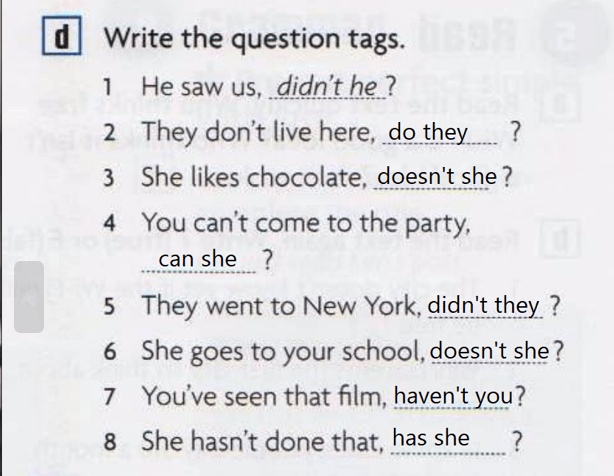
Put in the correct question tags for each sentence.
1. John smokes a lot, doesn’t he?
2. My mother has lovely hair, doesn’t she?
3. You do like this film we’re watching, don’t you?
4. He can’t speak English very well, can he?
5. Your brother isn’t married, is he?
6. She doesn’t cook very well, does she?
7. We can go to the cinema tomorrow if you want, don’t you?
8. They don’t have a very nice house, do they?
9. She is the richest woman in the town, isn’t she?
10. We should leave before it gets dark, shouldn’t we?
11. You’d like a cup of tea, wouldn’t you?
12. They mustn’t go too near the lake, must they?
13. You’ll see John tomorrow, won’t you?
14. We won’t be going to that restaurant again, will we?
15. Let’s try and phone her again, shall we?
16. You’ve seen this film already, haven’t you?
17. Your uncle has never been out of the village, has he?
18. You’re seeing Amy next week, aren’t you?
19. I’m not speaking first at the meeting, am I?
20. This was an interesting exercise, wasn’t it?
Question tags, present perfect simple, already and yet


English 11/10/2024
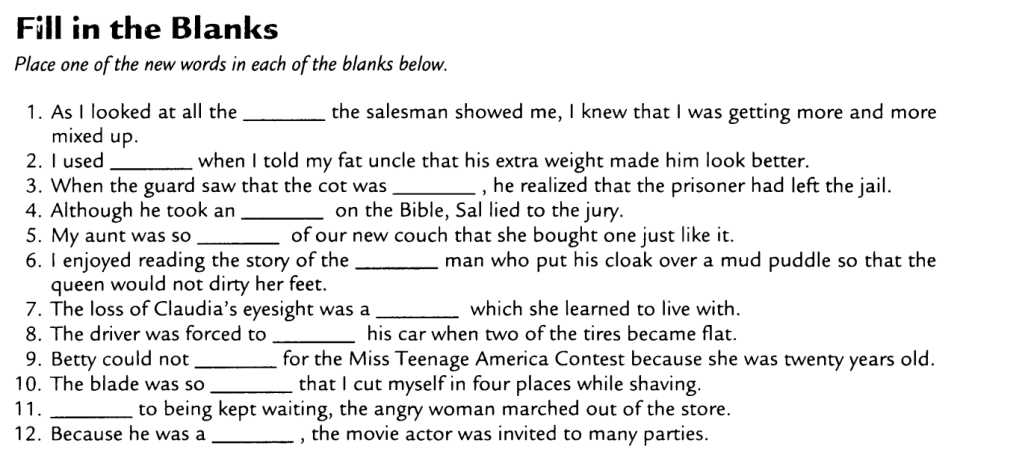
1. data
2. tact
3. abandoned
4. oath
5. jealous
6. gallant
7. hardship
8. abandon
9. qualify
10. keen
11. unaccustomed
12. bachelor

1. oath
2. keen
3. abandon
4. hardship
5. qualify
6. jealous
7. gallant
8. bachelor
9. data
10. tact
11. vacant
12. unaccustomed
A Marathon, Sports, Definition
1. A race in which people run on roads over a distance of 42 kilometres or about 26 miles
2. An activity that takes a long time to complete and needs a lot of energy and determination
ORIGIN AND USAGE
The word marathon comes from a Greek legend that tells the story of Pheidippides, who ran from the Plains of Marathon all the way to Athens in 490 BCE to spread the news of the Greeks’ victory over the Persian army. The running race based on the story was first introduced at the Olympic Games in 1896.
EXAMPLES
Marathon refers to a running race that stretches over 42 kilometres, or about 26 miles. Marathons require extensive training, sometimes lasting months, and completing a marathon is a significant accomplishment for most people. Marathons are held all over the world and the men’s marathon has been a part of the Summer Olympic Games since 1896 (the women’s marathon event was added to the Olympics in 1984).
Most marathons are run on paved road courses, which are relatively straight and easy to navigate. Recently, ultra-marathons have become more popular.
These marathons are run on more difficult courses that combine paved surfaces and dirt roads, mountain trails or other rugged terrain. Ultra-marathon courses also cover longer distances than traditional marathons – some courses can be 160 kilometres or more.
Many marathon enthusiasts agree that the most gruelling marathon in the world is the Barkley Marathons, held each year in the woods of Tennessee in the United States. The Barkley Marathons course covers between 97 km (the ‘fun run’) and 160 km (the full course) and requires runners to climb roughly 16,500 metres, almost twice the height of Mount Everest, over a period of 60 hours. More than a thousand runners have attempted the Barkley Marathons and only 15 have finished, two of them more than once.
English in Mind, pages 24, 25, 26, 27
 ୨ৎ Արփի Փիրումյան 𝜗ৎ